Making sense of the Paris killings?
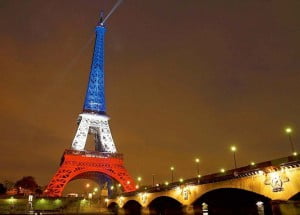 Even a few days on, information technology is hard to take in the horror of the Paris killings, and experience of those affected and their families. There are still those who exercise not know whether their relatives are live and wounded or dead. But it hasn't taken long for a whole series of questions to exist asked—despite the personal and emotional bear upon, we practice desire to make some sense of what has happened, to find causes and explanations.
One reaction to the events has been to highlight that this kind of horror is happening all over the world—why are we so shocked by this, when something similar happened only the day before in Beirut, all the same this created hardly a flicker in our news coverage? Are we racists in our news coverage? The reality is that even if all people thing equally, not everyone matters in the same wayto us; we have a personal and emotional connectedness to those near us which nosotros don't have to those far abroad. In fact, these other events were reported very fully; just in the echo-chamber that is social media, they didn't get passed on. Sometimes globally connected news confronts us with too much reality, and it is besides painful. Statistically, the killings make very little actual difference every bit to how condom we are; the effect is to create a climate of fear, and immersing ourselves in the story simply exaggerates that.
There was a moving moment of solidarity at the offset of the England-France friendly football game match at Wembley. Mayhap football game can answer the universal questions of human beingness? If but information technology were that simple. (Rather less moving was David Cameron's utterance in a faux Old Etonian French accent 'Nous sommes tous ensembles'.) Although in that location are conspicuously shared cultural values between Great britain and French republic, there are likewise of import differences, and they are highly significant in thinking nearly the Paris attacks. In a moment of synchronicity, Andrew Marr's Start the Week on Mon was a 'France Special', recorded in Paris on the morning time of the attacks, though of form not commenting on them. Apart from France's commitment to freedom (liberté) which is non matched in Britain, the programme highlighted the, at times ruthless, opposition to the influence of religion in public life, especially during the 1960s under Georges Pompidou.
This raises the two cardinal issues which need both cultural awareness and theological reflection. I (liberty) has to practise with the context of the attacks; the other (faith) has to exercise with causes.
Modern belief in the virtue of human autonomy and freedom finds information technology hard to come to terms with men and women as fallen besides as creative. Every freedom we are given creates opportunities for human innovation, but at the aforementioned moment offers a chance for sin to flourish. The freedom to create efficient factories where goods can exist made more than cheaply and greater value added is the liberty for upper-case letter to accrue in the hands of a few and for inequality to grow unchecked. The freedom to connect with people and sustain relationships across the world is also the freedom for the global spread of pornography and the sinister dealings of the dark web. Freedom of move across Europe has helped the economy grow, but it has also allowed criminals to extend their networks unchecked and for terrorist to travel from Belgium to France unhindered.
As Alan Storkey continues to highlight, the world is brimful with armaments, and information technology is this which provides the opportunity for disharmonize even if it is non directly the cause. France has strict firearms sales regulations, simply this is meaningless when there are several one thousand thousand small arms floating effectually Europe, left over from conflicts in the Balkans and elsewhere.
The gratuitous movement of people in Europe was already put under intolerable pressure past the rapid influx of migrants and refugees from Syria and elsewhere. But when 1 of these turned out to exist part of the Paris attacks, freedom of move has reached breaking betoken.
Freedom to read nigh the things that interest me and my friends on social media creates a blinkered outlook which ignores import things I might choose not to look at but which notwithstanding affair.
"Why didn't the media cover *insert country here*?" appears to actually be autograph for "Why wasn't this story shared extensively on my Facebook feed?"
The attacks might have been easier to prevent and the perpetrators easier to runway if Paris the level of CCTV that London has—just this has raised serious questions here about civil liberties.
We cannot brand sense of the context of the attacks unless we think carefully—and theologically—virtually what human freedom means, for good and for ill.
But understanding the context doesn't aid us understand the cause. Many of the young men fatigued to the influence of ISIS are not motivated by faith.
They are woefully ignorant about Islam and have difficulty answering questions about Sharia law, militant jihad, and the caliphate. Merely a detailed, or even superficial, knowledge of Islam isn't necessarily relevant to the ideal of fighting for an Islamic State, as we take seen from the Amazon order ofIslam for Dummies by 1 British fighter bound for ISIS.
They are interested in a sense of purpose and excitement, wanting to escape from the restrictions and tedium of their current situation. But this cannot be separated from the ghettoisation of thebanlieues in Paris, or the effect of Western policy in Arab countries.
They are children of the occupation, many with missing fathers at crucial periods (through jail, decease from execution, or fighting in the insurgency), filled with rage against America and their ain government. They are not fueled by the idea of an Islamic caliphate without borders; rather, ISIS is the outset group since the crushed Al Qaeda to offer these humiliated and enraged young men a way to defend their dignity, family unit, and tribe. This is not radicalization to the ISIS mode of life, simply the promise of a way out of their insecure and undignified lives; the hope of living in pride as Iraqi Sunni Arabs, which is non just a religious identity merely cultural, tribal, and land-based, also.
Nosotros might non desire to read this, but past policy has, if anything, created, rather than solved this trouble.
We gave upwards many of our freedoms in America to defeat the terrorists. Information technology did non work. We gave the lives of over 4,000 American men and women in Iraq, and thousands more in Transitional islamic state of afghanistan, to defeat the terrorists, and reject to enquire what they died for. We killed tens of thousands or more in those countries. It did not work. We went to war again in Iraq, and at present in Syrian arab republic, earlier in Libya, and only created more failed states and ungoverned spaces that provide havens for terrorists and spilled terror like dropped pigment across borders. Nosotros harass and discriminate against our own Muslim populations and then stand slack-jawed as they become radicalized, and all we do and so is blame ISIS for Tweeting.
If then, then in declaring 'war on terror', France could be making the aforementioned mistake that the United states of america made afterward nine/11.
It might be tempting, then, to suggest that 'this has naught to do with religion.' The problem here is that this is non much more than the attempt of secularisation to confine religion to the private and the personal—and information technology makes no sense of the action of the religious, either for expert or for ill.
Most people want a gild built on justice and compassion, which is hallmarked by reconciliation, forgiveness, love and generosity. Merely these virtues will not be generated simply by our own goodwill or our innate qualities, as optimistic humanists believe. Religion and religion will e'er have a major office to play in public and community life because of the need for a deeper ground to these values than what is offered by contemporary moralism.
In particular, those perpetrating these attacksdo make connections with religion, and explicitly connect them with central behavior within a particular understanding of Islam.
In French republic, United kingdom of great britain and northern ireland, Germany, America and almost every other country in the globe it remains regime policy to say that any and all attacks carried out in the name of Mohammed have 'nothing to practise with Islam'. Information technology was said past George W. Bush afterward 9/11, Tony Blair later vii/7 and Tony Abbott after the Sydney attack last month. It is what David Cameron said after two British extremists cut off the head of Drummer Lee Rigby in London, when 'Jihadi John' cut off the head of aid worker Alan Henning in the 'Islamic Land' and when Islamic extremists attacked a Kenyan mall, separated the Muslims from the Christians and shot the latter in the head. It was what President François Hollande said afterward the massacre of journalists and Jews in Paris in January. And it is all that most politicians will be able to come out with again later the latest atrocities in Paris.
All these leaders are incorrect.
Graeme Wood offers a very detailed and interesting business relationship of what ISIS are interested in and what their aims are. Merely mayhap the best theological account of the situation comes from John Azumah. He highlights Christian concern with Islam and its credible delivery to violence.
In other words, for virtually Evangelicals, Islam is the trouble because information technology warrants the violence of jihadi groups. The claim is not without grounds. Opposite to repeated Muslim denials, primal aspects of the ideology of radical tearing Muslim groups are indeed rooted in Islamic texts and history. Al-Qaeda, IS, and Boko Haram have their origins mainly in Wahhabi and Salafi thought. These are traditions of fundamentalist Islamic interpretation that have widespread influence across the Muslim world. Founding leaders of jihadi groups have either been students of leading Wahhabi-Salafi scholars or were inspired by their works.
But he goes on to highlight the complexities of Islam's traditions (which match the complexities of Christian tradition) and the critique that existsinside Islam of jihadism.
Even so, it is equally misleading to argue that the jihadi groups correspond the truthful face of Islam. While the legal and doctrinal edicts that the jihadists cite are integral parts of Islamic law, the jihadists without question violate that police by taking it into their own easily. Their failure to consider the conditions necessary for the declaration of jihad, too as for its proper conduct, provides an obvious example. Questions of which groups can be targeted, and of how and toward what end, are enormously complicated and sharply qualified in the authoritative legal texts.
This raises sharp questions for Muslim leaders:
As a Christian scholar of Islam, I offer a short list of questions that require frank give-and-take with Muslims…is information technology non fourth dimension for Islamic scholars and leaders to reexamine the doctrines that are then easily driveling by extremists? Isn't the orgy of claret we are witnessing today a clear sign of the demand for important and thoroughgoing reforms?
Merely it also raises primal questions for us. The jihadists by and large come from Wahhabi traditions, and are funded by Wahhabists in Kingdom of saudi arabia. Where does this money come from? Primarily from Western countries who buy their oil. The complexities of the Paris attacks is worth reflecting on the next time you fill up upward your auto with petrol.
Follow me on Twitter @psephizo
Much of my work is done on a freelance basis. If you take valued this mail, would you considerdonating £1.20 a month to back up the production of this blog?
If you enjoyed this, do share information technology on social media (Facebook or Twitter) using the buttons on the left. Follow me on Twitter @psephizo. Like my folio on Facebook.
Much of my work is done on a freelance footing. If you take valued this post, yous can brand a single or repeat donation through PayPal:
Comments policy: Good comments that engage with the content of the postal service, and share in respectful debate, can add real value. Seek first to understand, then to be understood. Make the most charitable construal of the views of others and seek to larn from their perspectives. Don't view debate as a conflict to win; address the statement rather than tackling the person.
Source: https://www.psephizo.com/life-ministry/making-sense-of-the-paris-killings/
0 Response to "Making sense of the Paris killings?"
Postar um comentário