Do You Have to Take the Drivers Test Again When You Turn 21
Topics:
- Right-of-Way
- Emergency Vehicles
- Move Over Law
- Blue, Green and Amber Lights
- Turns
- U-Turns
- Chapter 5 Quiz
Note: Practice quizzes are available only for those sections of the transmission covering rules of the road (Chapters 4 through xi and Road Signs).
Nigh traffic crashes occur at intersections when a driver makes a plough. Many occur in large parking lots that are open up to public apply, like at shopping centers. To prevent this type of crash, you must understand the correct-of-way rules and how to make correct turns.
Right-of-Way
Traffic signs, signals and pavement markings do not e'er resolve traffic conflicts. A green light, for example, does non resolve the conflict of when a machine turns left at an intersection while an budgeted car goes direct through the intersection. The correct-of-way rules help resolve these conflicts. They tell y'all who goes beginning and who must expect in different conditions.
Here are examples of correct-of-way rules:
- A driver who approaches an intersection must yield the right-of-style to traffic that is in the intersection.
Example: Yous approach an intersection. The traffic light is green and you lot want to drive straight through. Some other vehicle is already in the intersection making a left turn. You must let that vehicle complete its plough before you enter the intersection.
- If drivers approaching from opposite directions reach an intersection at about the aforementioned time, a commuter that turns left must yield to traffic that moves direct or turns correct.
Example: You want to plow left at an intersection alee. A vehicle reaches the intersection from the contrary direction and moves straight ahead. You must wait for approaching traffic to go through before you turn. You lot may enter the intersection to ready for your left plough if the calorie-free is dark-green and no other vehicle ahead of you lot plans to brand a left turn (see "Turns" later in this chapter). When you lot enter the intersection, keep to the right of the center line. Proceed your wheels straight to prevent existence pushed into oncoming traffic if your vehicle is hit from behind. When traffic headed toward you clears or stops for a red light, complete your plough when you can practise so safely.
You must as well yield to traffic headed toward y'all when you plough left into a driveway, parking lot or other area, fifty-fifty if there are no signs or signals that control the plough.
For any left turn, the law requires you to yield to whatsoever traffic headed toward y'all that is close enough to exist a hazard. The conclusion about when traffic is likewise shut takes experience and judgment. If yous accept whatever concern, wait for traffic to pass before you plow left.
- At intersections non controlled past signs or signals, or where two or more drivers terminate at Stop signs at the same time and they are at right angles, the driver on the left must yield the right-of-way to the driver on the right.
Instance: You are stopped at a stop sign and you are going to become straight through the intersection. A commuter on the cross road has stopped at a stop sign on your right and is also going to go directly. You must yield the right-of-mode to the other commuter.
- A vehicle that enters a roadway from a driveway, alley, private route, or another place that is not a roadway, must end and yield the right-of-way to traffic on the roadway and to pedestrians.
Instance: You are driving out of a parking lot and turn right as you enter a street. A vehicle approaches from your left. You must stop and wait for the vehicle to pass before you enter the street. If you were to turn left, you would have to yield to vehicles that arroyo from both directions. If a pedestrian walked across the parking lot get out, y'all would accept to await for that person to go across.
- Drivers must yield to pedestrians who legally use marked or unmarked crosswalks. This means you must tedious downwardly or stop if necessary.
Example: Y'all are stopped at a scarlet lite. A pedestrian steps into the crosswalk, and then the low-cal turns green. You must look for the pedestrian to go across. You must also yield to pedestrians in crosswalks on your left or right before you turn.
- You cannot enter an intersection if traffic is backed upward on the other side and you can not get completely through the intersection. Await until traffic ahead clears, so you do non block the intersection.
- Be alert to cross-streets or outset intersections and so that yous don't cause gridlock past blocking some other street.
- A driver who enters a traffic circle or rotary must yield the right-of-manner to drivers already in the circle. (For more data on how to drive in a rotary see "How to Bulldoze Through a Roundabout" in Chapter 8 of this manual.)
Emergency Vehicles
You must yield the right-of-style to burn down, ambulance, police and other authorized emergency vehicles when they respond to emergencies. They will brandish lights that are flashing red, ruddy and blue or red and white and sound a siren or air-horn. When you hear or see an emergency vehicle heading toward your vehicle from whatsoever direction, safely pull over immediately to the right edge of the road and terminate. Wait until the emergency vehicle passes before you drive on. If you are in an intersection, drive out of it earlier you pull over.
You must pull over and end for an emergency vehicle even if it is headed toward you in the opposite lane of a two-way roadway.
If you hear a siren or air-horn close past just exercise non know exactly where the emergency vehicle is, y'all can safely pull over to the correct-side edge of the road and finish until you are sure it is not headed toward you.
An emergency vehicle that uses lights and a siren or air-horn can exist unpredictable. The driver can legally exceed the speed limit, pass red lights and STOP or YIELD signs, go the wrong way on 1-mode streets and turn in directions not normally allowed. Although emergency vehicle drivers are required to be careful, be very cautious when an emergency vehicle heads toward you.
Move Over Law
This law requires every driver to practise care to avoid colliding with an authorized emergency or chance vehicle that is parked, stopped or standing on the shoulder or any portion of the highway with its emergency lights activated or i or more amber hazard lights activated or combination of one or more amber lights and one or more blue lights activated. Drivers must reduce speed on all roads when encountering such vehicles, but on parkways, interstates and other controlled admission roads with multiple lanes, drivers are further required to motion from the lane side by side to the emergency or hazard vehicle unless traffic or other hazards prevent doing so safely. Drivers are also required to move over for vehicles with blue and light-green lights which are described in the side by side section. Violations of this law are punishable as a moving violation.
Blue, Green and Bister Lights
Personal vehicles driven past volunteer fire fighters responding to alarms are allowed to display blueish lights and those driven by volunteer ambulance or rescue squad members tin can display green lights. Amber lights on hazard vehicles such equally snow plows and tow trucks, or the combination of bister lights and rear projected blue lights on hazard vehicles designed for towing or pushing disabled vehicles, warn other drivers of possible dangers. Flashing amber lights are also used on rural postal service delivery vehicles and school buses to warn traffic of their presence. The vehicles that display blueish, light-green or bister lights are not authorized emergency vehicles. Their drivers must obey all traffic laws. While you are non required to yield the right-of-way, you should yield as a courtesy if you tin can safely practise so.
Turns
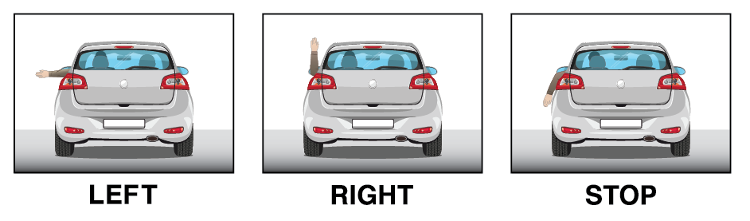
Always signal before y'all turn or modify lanes. It is important that other highway users know your intentions. The law requires you to signal a turn or lane change with your turn lights or hand signals at least 100 feet (xxx thou) alee. A skillful rubber tip is, when possible, to signal your intention to plow before you lot begin to brake or make the turn. The proper hand signals are shown below.
Remember these other tips when you prepare to plough:
- Reduce your speed.
- Be alert for traffic on all sides. Accept special caution to check for motorcycles. Most crashes that involve motorcycles and other vehicles are caused because the driver of the other vehicle has failed to see the motorcycle.
-
Keep your wheels straight until you really begin to make your turn. If your wheels are turned and you are hit from behind, your vehicle could be pushed into the oncoming lane of traffic.
- Remember that your rear wheels will travel inside the path of the front end wheels, nearer to the curb (right plough) or to traffic headed toward you lot (left turn).
- Watch for pedestrians, bicyclists and moped riders, especially on right turns. They are oft difficult to encounter in traffic.
-
Be particularly alert to individuals in cycle chairs, people pushing strollers, or someone pulling a wheeled suitcase behind them. They may be closer to the basis and subconscious behind a car.
The following illustrations evidence the right position of your vehicle for turns. These positions are from requirements in the law, and are not just good advice.
RIGHT Plow:
As you gear up to turn, get as far to the correct as possible. Practise non brand wide, sweeping turns. Unless signs direct you to do otherwise, turn into the right lane of the road you enter. See the instance below.
LEFT TURN FROM ONE-Manner Road INTO ONE-Style Route:
Move into the left lane when you set up to plough. If the road you lot enter has 2 lanes, you must plow into its left lane. See the example beneath.
LEFT Plough FROM 1-WAY Road INTO TWO-WAY Road:
Approach the plow in the left lane. As you proceed through the intersection, enter the two-way route to the right of its middle line, but as shut as possible to the middle line. Be alert for traffic that approaches from the road to the left. Motorcycles are difficult to run into, and information technology is hard to judge their speed and altitude away. See the instance beneath.
LEFT Plough FROM Two-Style ROAD INTO Ii-Way Route:
Arroyo the turn from the right half of the roadway closest to the center. Try to use the left side of the intersection to help make sure that you do not interfere with traffic headed toward you that wants to turn left. Go along to the right of the heart line of the road you enter, only every bit close every bit possible to the center line. Be alarm for traffic, heading toward yous from the left and from the lane you are about to go across. Motorcycles headed toward you are difficult to meet and it is hard to approximate their speed and distance away. Drivers often neglect to encounter a motorcycle headed toward them and hit it while they turn across a traffic lane. Meet the instance below.
LEFT TURN FROM Two-WAY ROAD INTO 1-Mode ROAD:
Arroyo the turn from the right one-half of the roadway closest to the center. Make the turn before you reach the center of the intersection and turn into the left lane of the road you enter. See the case below.
LEFT Plow FROM TWO-WAY ROAD INTO FOUR-LANE HIGHWAY:
Approach the turn from the correct one-half of the roadway closest to the center. Enter the left lane, to the correct of the centre line. When traffic permits, you can move out of the left lane. See the instance beneath.
U-Turns
A "U-plough" is whatsoever plow you brand then y'all tin can go on in the reverse management.
Practice not attempt a U-turn on a highway unless admittedly necessary. If you must turn around, use a parking lot, driveway or other area, and, if possible, enter the roadway every bit yous motion forward, not backing up.
You tin make a U-plough only from the left portion of the lane nearest to the centerline of the roadway, never from the right lane. Unless signs tell you lot otherwise, you tin can brand a U-turn when yous get permission to go on by a green pointer left-plough traffic signal, provided it is immune and you yield to other traffic.
Y'all can not make a U-turn near the tiptop of a hill, a bend or whatever other location where other drivers can not see your vehicle from 500 anxiety (150 1000) away in either direction. U-turns are too illegal in business districts of New York Metropolis and where NO U-TURN signs are provided. You can never brand a U-plow on a limited access motorway, even if paths connect your side of the expressway with the other side. In addition, information technology is prohibited for a vehicle to brand a U-turn in a school zone.
Unless prohibited, a 3-point turn may be used to turn around on a narrow, ii-way street. You may be required to brand a 3-point plough on your road exam.
To make a 3-bespeak turn:
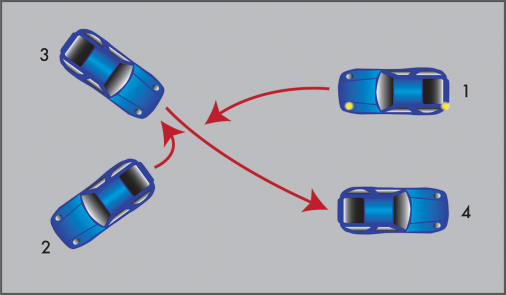
- Signal with your right plow indicate, so pull over to the right and stop. Indicate with your left plough signal, then bank check advisedly for traffic from all directions.
- Turn left, get across the road so you come to a stop while you confront the left curb or edge of the road.
- Look again for traffic. Turn your steering cycle as far to the right as possible, and so look backside y'all as you back up. Stop before you reach the right curb or any obstacle to the correct curb or border of the road.
- Stop, bank check again for other traffic, then turn your steering wheel all the fashion to the left and pull forrad to complete your plough when it is prophylactic.
Questions
Before you go on to Affiliate 6, make sure you lot can answer these questions:
- What is the mitt signal for a stop? A right turn?
- If ii drivers enter an intersection from opposite directions at the same time, and i travels straights, the other prepares to turn left, which must yield the right-of-style?
- If you enter an intersection to brand a left turn, but oncoming traffic prevents the turn immediately what should you practice?
- If you achieve an intersection that is not controlled at the same time every bit a commuter on your right, and both of you lot prepare to become straight, who has the right-of-mode?
- What must yous practice if you enter a road from a driveway?
- You face a green light, but traffic on the other side of the intersection does non let you to travel all the way through the intersection. May you enter the intersection?
- Does a vehicle prepared to enter a traffic circle or rotary accept right-of-manner over vehicles already in the circumvolve?
- What will you practise if you hear a siren nearby but cannot see where the emergency vehicle is?
- How far before a turn must you lot signal?
- When you prepare for a right turn, should you remain as close to the eye of the lane as possible?
- Where must you position your vehicle when you set to brand a left plow from a two-way roadway into a ane-way roadway?
End of Chapter 5:  Chapter five Quiz
< Chapter iv | Contents | Chapter six >
Source: https://dmv.ny.gov/about-dmv/chapter-5-intersections-and-turns
0 Response to "Do You Have to Take the Drivers Test Again When You Turn 21"
Postar um comentário