How to Upload Sounds Into a File
This folio is nigh importing audio files into Audacity (like WAV or MP3) that other applications on the estimator can play.
 | Audacity projects cannot be opened using the control, you will get an fault message. If you lot take already saved your sound as an Audacity Projection, use or to open the <my_project_name>.aup3 . |
Contents
- Audio File Formats Supported by Audacity
- 3 Ways to Import Audio
- Metadata
- Using the file type dropdown carte du jour in the Open and Import Audio Dialogs
- Importing audio from CDs
- Sample Rate and Sample Format of imported files
Sound File Formats Supported past Brazenness
The audio formats importable by Audacity with the command, equally shipped are:
Uncompressed sound formats
For uncompressed audio: almost WAV and AIFF files including all PCM variants tin be imported into Audacity
Compressed audio formats
Compressed sound: MP3 , Ogg Vorbis , FLAC and MP2 tin be imported into Brazenness.
FFmpeg for other importable audio formats
You lot can install the optional FFmpeg library to import a much larger range of audio formats including AC3, AMR(NB), M4A, MP4 and WMA (if the files are not DRM-protected to work only in particular software).
FFmpeg will as well import sound from nearly video files or DVDs that are not DRM-protected.
Older uncompressed file types such equally WAV with U-Law or IMA ADPCM encoding are mostly supported provided they contain correctly formatted header information.
- If files practise not have header information (such as RAW or Vocalization ADPCM) or have non-standard header information, you tin normally import them using .
- WAV files from portable recorders may incorporate proprietary compressed audio. These should not exist imported as Raw Information, but by installing the FFmpeg library.
- LOF files (lists of files) are also supported if the list is correctly formatted and contains supported files.
 | When importing an MP3 sound file you may see the post-obit mistake bulletin:
Workarounds for this can be found at Opening malformed MP3 files. |
Iii Means to Import Audio
No matter which method you use to bring an sound file into Audacity, the file is always imported into a saved or unsaved Brazenness project. The imported file always appears in a new track in that project.
1.
If you lot select the command, then cull 1 or more audio files, Audacity will import the selected file(southward) into the existing projection. This is useful to bring the content of one or more sound files into a project that already contains audio (for example, to mix several audio files together).
ii. (Open Recent on Mac)
This command imports a unmarried file from a list of the 12 most recently imported files or recently saved projects. The file opens in a new window exactly equally .
three. Drag and drib
 | Note that you cannot use elevate and driblet an AUP3 projection into an open Brazenness Project window. To open Audacity projects - use to open projects. |
- On Windows and Mac:
- Drag and drop one or more audio files into an open Audacity project window: this is equivalent to .
- Elevate and drib one or more audio files onto the Audacity icon: this is equivalent to .
- On Linux:
- Elevate and drop files into an open up Audacity Project window: this is equivalent to .
- Elevate and drop one or more audio files onto the Audacity icon: only the outset file will open. More than one file dragged and dropped onto the icon volition do the same every bit the control for the first file, merely the other files volition generate an error message proverb that Audacity is already running.
Metadata
Audio files can acquit descriptive information in a metadata container, this allows information such as the championship, artist, album, track number, and other data about the file to be stored in the audio file itself.
Each time an audio file is imported into the aforementioned project window, the metadata tags for that file replace the previously stored metadata for the project. And then if the concluding imported file has no metadata, the project will no longer have any stored metadata. Using one of the above methods that imports each file into its own project window will ensure each file's metadata is stored.
This bill of fare (called "Format" on Mac) contains a listing of different file types.
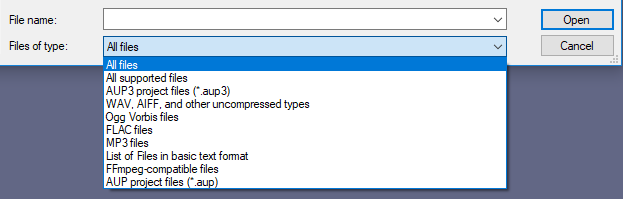
Choosing a particular file type in the bill of fare performs two functions.
- The file type choice filters the list of files in the window by restricting it to files of that blazon.
- The file blazon pick determines which importer attempts the file first when using the Open up or Import Audio dialogs. For case, a WAV file could be imported past Audacity's native WAV importer or by the optional FFmpeg library if this was installed.
- Additionally, rules for the guild in which unlike importers attempt files of particular types can be created at Extended Import Preferences with an option to over-ride the Open and Import Sound file type option. Come across Import Filtering and Importer Order for more than details.
- Import can as well exist used to import a listing of sound files by selecting List of Files in basic text format. See LOF Files for more than details.
Importing sound from CDs
Audacity does not contain any function for importing (ripping) sound from CDs. This tin can, yet, be achieved by using other applications to excerpt the information into a file format Brazenness does support.
See the tutorial How to import CDs.
Sample Charge per unit and Sample Format of imported files
Audacity always imports files at their original sample charge per unit , as displayed in the Runway Information Surface area of the Track Control Panel.
When importing a file into an empty projection window (equally always happens when using as described below), the Project Rate control in Selection Toolbar changes if necessary to reflect the charge per unit of the file. The Projection Rate determines the sample charge per unit a file will exist exported at, so no further adjustment is needed to consign that file at its original rate. Nevertheless, once there is already an audio rails of any origin in the projection (either an imported file, a recording or generated audio), importing an sound file will never alter the project charge per unit.
Generally, Audacity imports files at the sample format (flake depth) specified at Default Sample Format in Quality Preferences. This setting defaults to 32-flake bladder. Therefore by default an imported file will show in the Track Control Panel as 32-bit float, even if its original bit depth is lower. This is best for high-quality editing. Even if you choose a lower Default Sample Format than 32-bit float, Audacity will never downconvert a file that has a higher flake depth, as shown in the following table for WAV and AIFF imports using the standard uncompressed files importer.
-
Resolution of imported WAV and AIFF files using standard importer Default Sample Format File bit depth Resolution imported at 16 16 sixteen 16 24 32 xvi 32 32 24 16 24 24 24 32 24 32 32 32 (default) xvi 32 32 (default) 24 32 32 (default) 32 32
OGG is unusual in that it will ever import at xvi-bit resolution using the standard OGG Vorbis importer, irrespective of Default Sample Format. This is due to the design of the OGG codec. However OGG tin be imported at 32-bit resolution using FFmpeg, as described at Using the file type dropdown menu.
Links
> Exporting Audio
> FFmpeg import/consign libraries for more than formats
> Metadata Tags Editor
Source: https://manual.audacityteam.org/man/importing_audio.html
0 Response to "How to Upload Sounds Into a File"
Postar um comentário